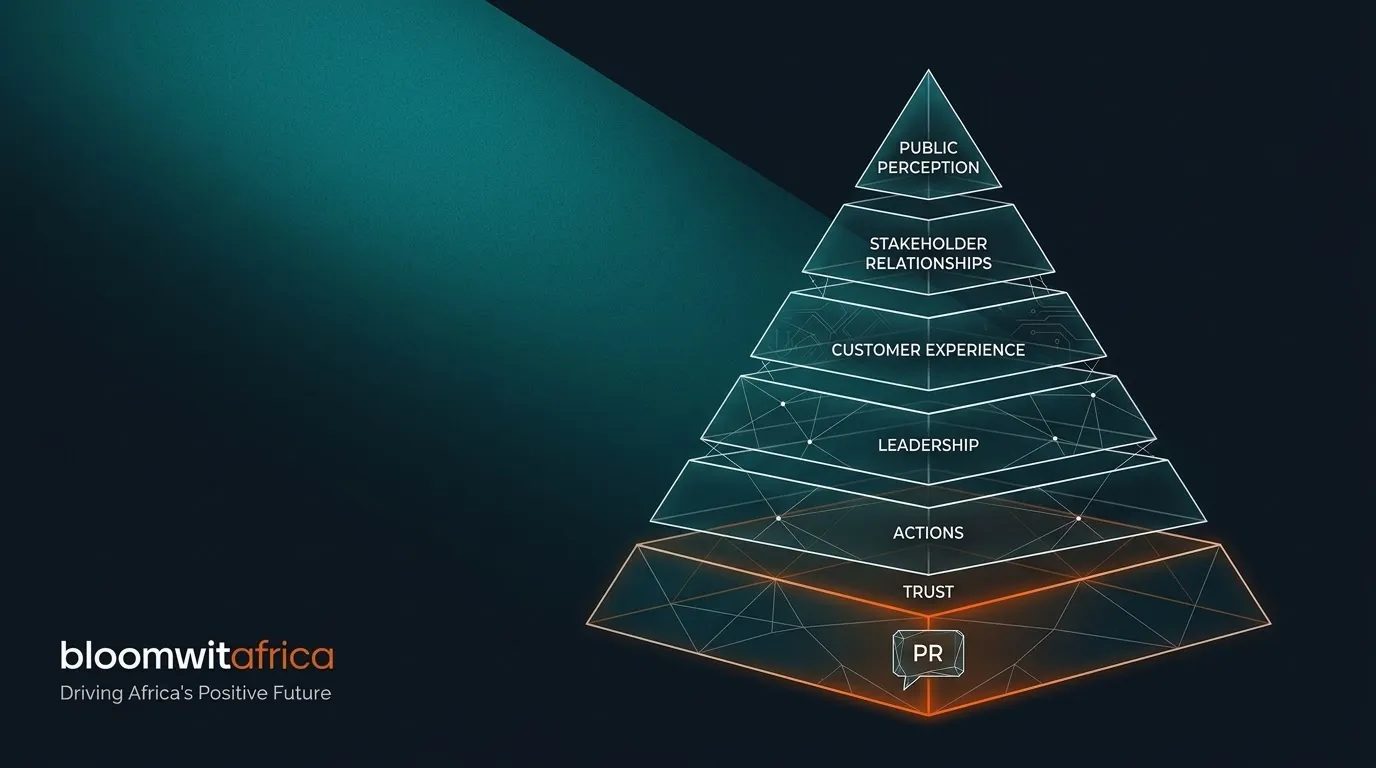
Reputation is a material business risk, not a communications metric. Here is what African boards should be measuring, discussing, and challenging before a crisis forces the conversation.
Most African boards encounter reputation after something has already gone wrong. By then, the conversation is about damage rather than governance. The questions being asked are often about response, not exposure. Reputation is a business risk. It belongs in board-level risk discussions alongside regulatory, financial, operational, and market risks. That means boards need better reputation reporting. They need evidence that shows whether stakeholder trust is strengthening or weakening, where risks are emerging, and whether the organization is prepared to respond.
Why boards see the wrong information
Much of the communications reporting that reaches boards focuses on agency activity. It lists media placements, impressions, reach, social media activity, and sometimes advertising value equivalency. These figures may demonstrate output, but they rarely explain business’s impact. A board needs to know something more fundamental: Is the organization’s reputation improving or deteriorating among the people who influence its future? That includes investors, regulators, customers, employees, partners, communities, policymakers, and the media. The difference matters. PR measurementtracks activity. Reputation measurements examine perception, exposure, and risk. A board should not have to interpret dozens of pages of coverage reports to find out whether its reputation is becoming stronger or more vulnerable.
What a quarterly reputation report should contain
A useful board reputation report does not need to be long. It needs to answer the right questions.
1. Perception movement
Show how priority stakeholders currently view the organization. Track perception against a defined baseline and monitor movement over time. The direction of travel is often more useful than a single score. The question is not simply, “What do people think of us?” It is, “How is that perception changing, among whom, and why?”
2. Share of voice against named competitors
Coverage volume has limited meaning without context. Boards should see whether the organization is gaining or losing visibility against specific competitors in the conversations that matter. This can include media share of voice, message visibility, sentiment, and the quality of coverage.
3. Reputation risks and mitigation
This should be one of the most important sections of the report. Identify the narratives, issues, or stakeholder concerns that could damage the organization. Show whether each risk is growing, stable, or declining. Then show what management is doing about it. A board should never discover a material reputation risk for the first time during a crisis.
4. Crisis readiness
Crisis preparedness should be measurable. Boards should know whether the organization has an updated crisis communications plan, trained spokespeople, clear escalation procedures, and designated decisionmakers. They should also know when the crisis plan was last tested. A plan that exists in a folder but has never been tested is not the same as crisis readiness.
5. What changes next quarter
The final section should focus on decisions and priorities. It should identify the reputation risks being addressed, capabilities being strengthened, and stakeholder relationships requiring attention. The focus should be on what needs to change, not simply what the communications team plans to produce.
Six questions directors should ask
1. Who owns reputation risk?
If the answer is simply “communications”, the risk may be under-governed. PR and Communications teams help manage reputation. Executive leadership owns the business decisions that shape it. The board provides oversight. Reputation cannot be delegated entirely to a communications function.
2. When did we last measure perception, and against what?
Without a baseline, claims of improvement are difficult to prove. Boards should ask when the baseline was established, which audiences were included, and when the research was last repeated.
3. What is our single largest reputational exposure?
The answer should be specific. “Negative media coverage” is too broad. A useful risk statement identifies the issue, market, stakeholder group, and potential business consequences.
4. If a fabricated announcement appeared in our name tonight, how would we know?
This is no longer a theoretical question. The Africa Center for Strategic Studies documented 189 disinformation campaigns targeting African information environments. That represents a nearly fourfold increase from 2022. Organizations need to know how quickly they can detect false information, who verifies it, and who has authority to respond.
5. Which markets and languages are we not monitoring?
This question matters for organizations operating across multiple African markets. Monitoring only English-language media can create a distorted picture of reputation. Regional monitoring should reflect local media, social platforms, languages, and information networks.
Kenya illustrates the changing information environment. The Reuters Institute’s 2026 Digital News Report describes WhatsApp as an important channel for political information, rumors, and mobilization, alongside the growing influence of TikTok, YouTube, creators, and other digital platforms.
The broader lesson is clear: reputation monitoring needs to follow where audiences actually discuss and share information.
6. When did our spokespeople last face genuinely hostile questioning?
A media briefing is not a crisis simulation. Boards should ask whether executives have been tested under pressure, including difficult interviews, misinformation scenarios, hostile questions, and rapidly changing facts. Crisis readiness should be practiced before it is needed.
Why this matters more in African markets
African organizations operate in information environments where public accountability and media scrutiny remain significant. The latest Afrobarometer findings are instructive. Across 38 African countries, 72% of respondents support the media’s watchdog role, while 65% support the right of the media to publish without government control. At the same time, perceptions of media freedom are becoming more mixed. Across 30 countries tracked consistently, perceived media freedom fell by four percentage points. Nigeria recorded a 22-point decline.
This creates a complex reputation environment. Public demand for accountability remains strong, while information environments are becoming more fragmented. Traditional media, social platforms, messaging apps, creators, and informal networks all contribute to how narratives develop. A board can therefore receive accurate media coverage data and still miss a significant part of its reputation exposure.
Building a reputation risk register
A reputation risk register makes these risks easier to govern. A practical register can use four core fields:
Risk: Name the risk specifically. For example, “Regulatory concerns around licensing renewal in Kenya” is more useful than “negative coverage”.
Likelihood and impact: Score the risk using the organization’s existing risk framework.
Current mitigation: Record what is already being done. If there is no mitigation, say so.
Owner and next action: Assign a named executive and a clear deadline.
This exercise often exposes risks that have been discussed informally but never formally assigned. That is precisely why it matters.
Who should present reputation reporting to the board?
The agency should not be the primary owner of the board conversation. The executive accountable for reputation should present the findings, supported by the communications or PR agency’s analysis. This creates a useful separation between performance reporting and risk governance.As the best PR and communications agency in Africa, Bloomwit Africaprovides media intelligence, perception analysis, competitor tracking, and high-level recommendations for reputation design and reporting. We advise that organizations’ leadership needs to own the conversation about what reputation findings mean for their business.
Contact Bloomwit Africa to schedule your reputation risk assessment or discuss a retained communications program